Evaluating Top Decentralized Finance Projects: Architecture, Risk, and Selection Criteria
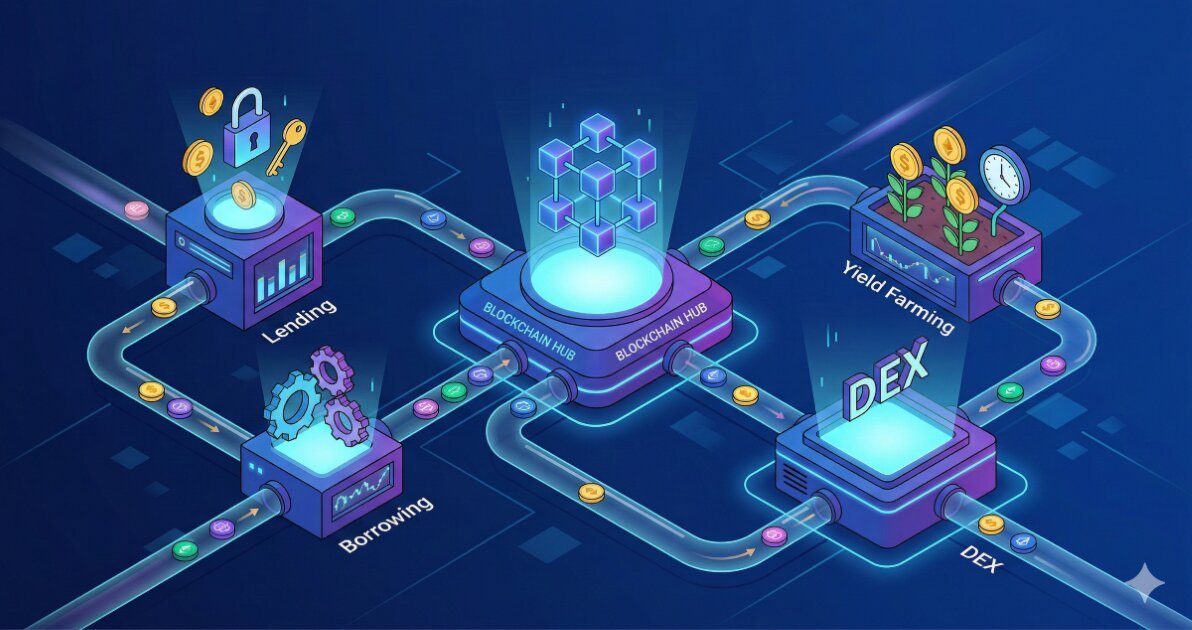
Decentralized finance projects are financial primitives built on programmable blockchains that allow users to borrow, lend, trade, and earn yield without intermediaries. The largest projects hold billions in total value locked, process hundreds of thousands of daily transactions, and serve as infrastructure for composable DeFi strategies. This article examines the technical and operational frameworks that distinguish mature protocols from newer entrants, focusing on the mechanics, risk surfaces, and evaluation criteria practitioners need when selecting protocols for integration or capital allocation.
Protocol Categories and Core Mechanics
DeFi projects typically fall into one of several functional categories, each with distinct mechanisms and trust assumptions.
Automated market makers (AMMs) enable onchain token swaps by maintaining liquidity pools where prices are determined algorithmically. Uniswap popularized the constant product formula (x * y = k), where liquidity providers deposit token pairs and traders pay fees that accrue to the pool. Curve Finance optimized the formula for stablecoin and like asset swaps, reducing slippage for correlated pairs. Balancer generalized AMMs to support pools with arbitrary token counts and weightings.
Lending protocols allow users to supply assets as collateral and borrow against them. Aave and Compound pioneered overcollateralized lending with variable interest rates set by utilization curves. When utilization is low, borrow rates fall to incentivize borrowing. As utilization approaches the target threshold (often 80 to 90 percent), rates increase sharply to encourage repayment and prevent liquidity crunches. Liquidation mechanisms automatically sell collateral when the health factor (collateral value divided by borrowed value) falls below the protocol threshold, typically 1.0 to 1.1 depending on the asset’s risk parameters.
Derivatives platforms replicate futures, options, and synthetic assets onchain. Synthetix uses a collateralized debt pool model where SNX stakers mint synthetic assets (synths) backed by their staked collateral. GMX and dYdX offer perpetual futures with funding rates that balance long and short exposure. Perpetual contracts have no expiry but charge periodic funding payments between longs and shorts to keep the contract price anchored to the spot price.
Liquid staking derivatives enable users to stake proof of stake assets while retaining liquidity. Lido issues stETH tokens representing staked Ethereum plus accrued rewards. The derivative token can be traded, used as collateral, or deployed in other DeFi protocols while the underlying asset remains staked. This composability unlocks capital efficiency but introduces smart contract risk and potential depegging events when redemption demand exceeds available liquidity.
Risk Architecture and Security Models
Protocol security depends on multiple layers: smart contract code, oracle integrity, governance processes, and economic incentives.
Smart contract risk is managed through formal verification, audits, and bug bounties. Protocols that have operated for multiple years without exploit typically have battle tested codebases. Upgradeable contracts introduce admin key risk because a compromised multisig or governance process can modify core logic. Immutable contracts eliminate this vector but cannot be patched if vulnerabilities are discovered.
Oracle dependency is critical for any protocol using external price data. Chainlink aggregates price feeds from multiple node operators with on-chain data validation. Protocols using single oracle sources or low liquidity price feeds are vulnerable to manipulation. Flash loan attacks have exploited protocols that rely on spot prices from small liquidity pools. Time weighted average prices (TWAPs) over multiple blocks provide better resistance to transient manipulation but lag during volatile price movements.
Governance attack surfaces vary by protocol. Token weighted voting allows whale governance or governance token acquisition attacks. Time locked execution periods (typically 24 to 72 hours) give users time to exit before malicious proposals execute. Multisig safeguards controlled by known entities provide faster response times for emergencies but reintroduce trust assumptions.
Economic exploits target incentive misalignments rather than code vulnerabilities. Recursive borrowing and lending across protocols can amplify leverage beyond intended limits. Liquidity mining programs that emit tokens faster than protocol revenue can sustain create inflationary spirals. Protocols with token emissions should demonstrate fee revenue sufficient to support token value independent of subsidies.
Worked Example: Collateralized Loan Health Monitoring
A user deposits 10 ETH as collateral in a lending protocol when ETH trades at 2,000 USD per token. The protocol assigns ETH a 75 percent loan to value ratio, allowing the user to borrow up to 15,000 USD worth of stablecoins. The user borrows 12,000 USDC, putting their position at 80 percent utilization.
The health factor equals (collateral value * liquidation threshold) / borrowed value. If the protocol sets the liquidation threshold at 80 percent, the health factor is (20,000 * 0.80) / 12,000 = 1.33. Liquidation triggers when this falls below 1.0.
If ETH drops to 1,500 USD, collateral value falls to 15,000 USD. The health factor becomes (15,000 * 0.80) / 12,000 = 1.0, placing the position at the liquidation boundary. Any further price decline or additional borrowing triggers liquidation.
Liquidators monitor for undercollateralized positions and can repay a portion of the debt in exchange for discounted collateral. The protocol typically allows liquidation of 50 percent of the debt position and offers liquidators a 5 to 10 percent bonus on the collateral value. In this scenario, a liquidator could repay 6,000 USDC and receive ETH worth approximately 6,300 to 6,600 USD depending on the liquidation bonus.
The borrower loses the liquidation penalty and may have their entire position closed if the health factor deteriorates rapidly. Monitoring tools that alert when health factors approach 1.1 give users time to add collateral or repay debt before liquidation.
Common Mistakes and Misconfigurations
- Ignoring correlation risk when using yield aggregators. Vaults that farm the same underlying protocol concentrate risk. Multiple strategies on Curve pools expose you to a Curve exploit across all positions.
- Assuming liquidity pool token value equals underlying asset value. LP tokens represent a claim on pool reserves that may be imbalanced. Withdrawing during periods of high imbalance realizes impermanent loss.
- Using isolated margin without monitoring liquidation thresholds per asset. Each collateral type has distinct loan to value ratios and liquidation thresholds. Mixing volatile and stable collateral in one position complicates health factor calculations.
- Deploying capital before verifying upgrade timelock periods. Protocols with short timelocks (under 24 hours) or no timelock can change parameters or introduce malicious code before users can react.
- Relying on APY displays without separating protocol fees from token emissions. Headline APYs often include emissions valued at current token prices. Calculate the sustainable yield from trading fees alone to assess long term viability.
- Failing to account for gas costs in automated strategies. Claiming rewards, rebalancing pools, or compounding yields on Ethereum mainnet can cost 20 to 100 USD per transaction. Low capital positions may lose money net of gas.
What to Verify Before You Rely on This
- Current total value locked and historical trends (check protocol analytics dashboards and blockchain explorers, not marketing materials)
- Smart contract audit reports and dates (verify audits cover the current contract version, not outdated code)
- Oracle implementation details and price feed sources (confirm multiple independent data sources for critical price feeds)
- Governance process documentation including timelock duration and execution procedures
- Liquidation parameters for each supported asset, including loan to value ratios, liquidation thresholds, and liquidation penalties
- Protocol fee structure and revenue metrics (compare fee income to token emissions to assess sustainability)
- Insurance coverage availability through Nexus Mutual or similar protocols
- Recent governance proposals and parameter changes (check the last 90 days for meaningful updates)
- Bridge implementations for crosschain deployments (verify each chain deployment separately)
- Emergency pause mechanisms and who controls them
Next Steps
- Examine protocol documentation to map the full transaction flow for your intended use case, including all intermediary contracts and external dependencies.
- Test interactions on a testnet or with minimal capital to verify expected behavior, gas costs, and edge case handling before committing significant resources.
- Establish monitoring for position health metrics, governance proposals, and protocol parameter changes that could affect open positions or deployed capital.
Category: Insights